Chenyang Wang 王晨阳
EdTech and HCI Researcher
"Advancing AI and Education for a Better Future!"

I am a Research Scientist (Collaborateur Scientifique) based in Switzerland🇨🇭, pursuing interdisciplinary research in Human-Computer Interaction, Human-Robot Interaction, and Learning Sciences. My current research explores how dialogue between humans and (embodied) AI systems can foster deeper learning and thinking, as well as how AI can open new possibilities for collaborative learning.
Broadly, I am passionate about designing and evaluating educational technologies that are effective, human-centered, and sustainable in real-world learning environments. My work combines human-centered design, system development, user studies in lab and classroom settings, and data-driven approaches to understand how emerging AI systems can better support both learners and educators.
I received my PhD from the Computer Human Interaction for Learning and Instruction Lab (CHILI Lab) at the Swiss Federal Institute of Technology Lausanne (EPFL), under the supervision of Prof. Pierre Dillenbourg. I am currently a Research Scientist working with Prof. Ken Holstein at CoALA Lab, and I am also partially affiliated with the HAIS Lab at BFH, working with Prof. Thiemo Wambsganss. Previously, I was a postdoctoral researcher at the MOBOTS Lab with Prof. Francesco Mondada.
News
| Jun 17, 2026 | I will be attending the Festival of Learning 2026 in Seoul, South Korea 🇰🇷, to present our paper, “Turning 500+ Students into Teachers: A Semester-Long Study of an AI Teachable Agent in an Undergraduate Algorithms Course”. |
|---|---|
| May 17, 2026 | I am honoured to be invited to give a guest lecture about “Collaborative and Social Learning”, in the course Design in Educational Technology 2026 taught by Prof. April Wang, at . |
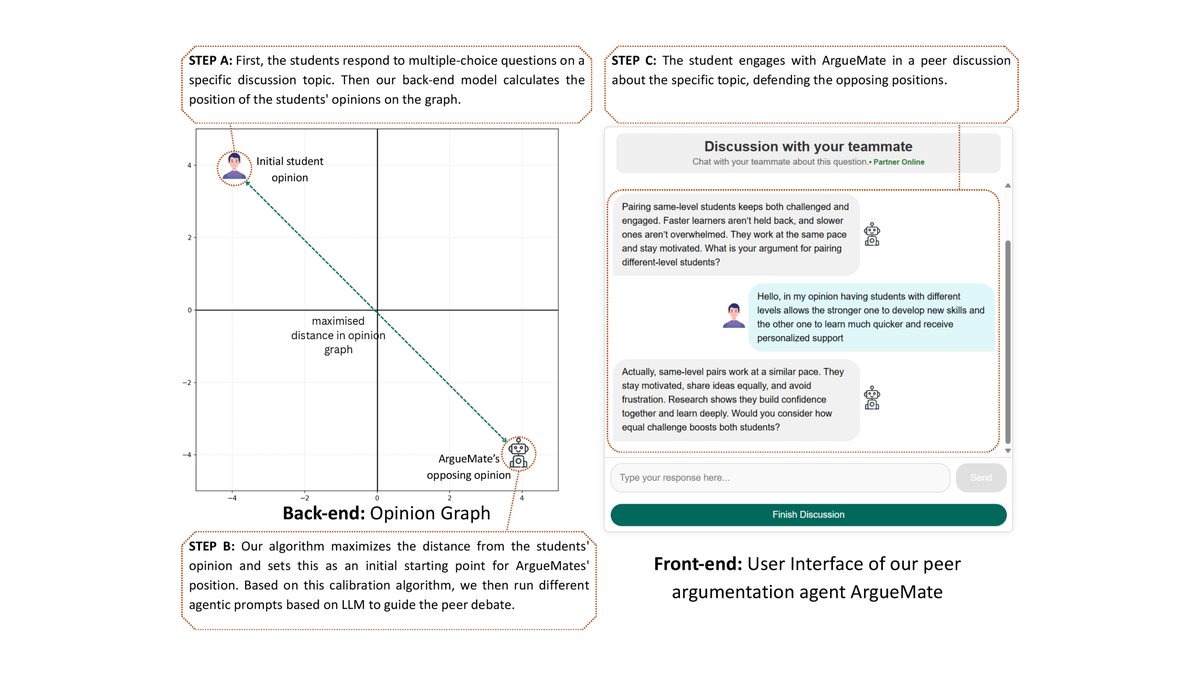
| Apr 10, 2026 | I will be presenting “ArgueMate: Designing an Arguing Agent with Maximised Disagreement to Support Student Peer-Argumentation Exercise” and chairing the session “AI for Language Learning & Communication Skills” at CHI 2026 in Barcelona, Spain. |
 .
.